Master the Game: A Beginner's Guide to Soccer on Field
November 5, 2025
Introduction
Ready to understand the world's most popular sport? This guide breaks down everything you need to know about playing soccer on field, from the layout of the pitch and the roles of each player to the core rules that make it all click. Think of this as your starting point for truly appreciating the beautiful game.
Why This Topic Matters
Soccer is so much more than a game—it's a global phenomenon that brings millions of people together. Its massive appeal is hard to grasp until you look at the numbers. The 1994 FIFA World Cup in the U.S., for example, drew a staggering 3,587,538 spectators, a record that still stands today. (You can see the details on Guinness World Records).
This guide will give you the confidence to watch, understand, and maybe even get out there and play. By the end, you'll see the field not just as a patch of grass, but as a chessboard where strategy, skill, and teamwork unfold. Whether you're trying to find the best soccer fields to play on or just want to follow the action like a pro, you’ve come to the right place.
The Ultimate Guide to Soccer on Field
Step 1: Decoding the Soccer Field Layout
Think of the soccer field, or ‘pitch,’ as the game board where every strategy unfolds. Getting a feel for its layout is the first real step to understanding how to play soccer on field. This is your map to every line, box, and arc that matters.
A soccer field is a simple rectangle, but the lines drawn on it give the game its structure. The outer boundaries are the touchlines (on the sides) and the goal lines (at the ends). When the ball crosses these, play stops and restarts with either a throw-in, a goal kick, or a corner kick.
The field is sliced in half by the halfway line, which is crucial for kick-offs and for calling offside. Right in the middle is the center circle, which has a 10-yard radius. During a kick-off, opponents have to stay outside this circle, which gives the starting team a clean, fair beginning to the match.
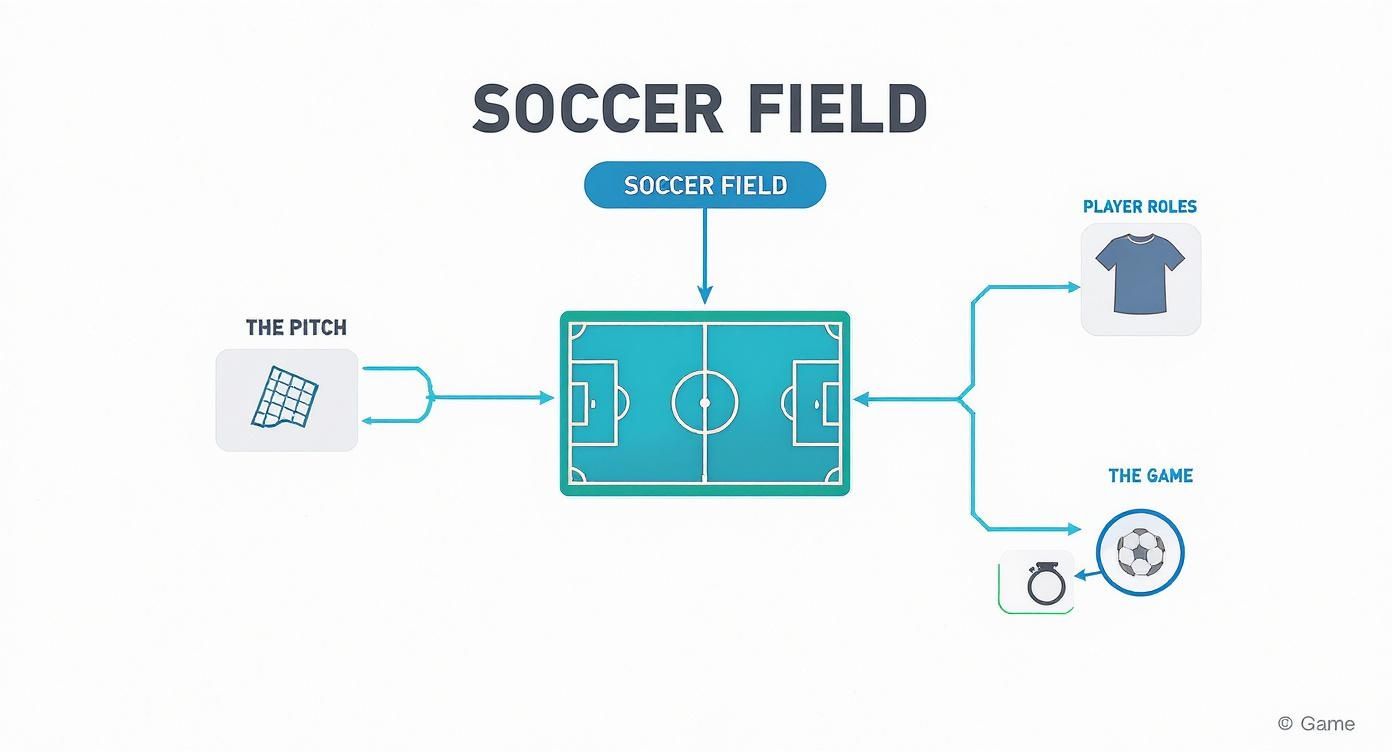
This table breaks down the most important markings you'll find on any regulation pitch and why they matter during a game.
| Field Marking | Primary Function | Key Rule Associated with It |
|---|---|---|
| Touchline | Marks the side boundaries of the field. | Ball is out of play. Restarted with a throw-in. |
| Goal Line | Marks the end boundaries of the field. | If attacking team kicks it out, it's a goal kick. If defending team kicks it out, it's a corner kick. |
| Halfway Line | Divides the field into two equal halves. | Used for kick-offs and helps determine offside positions. |
| Center Circle | A 10-yard radius around the center mark. | Opponents must stay outside of it during a kick-off. |
| Penalty Area | The larger box (18-yard box) in front of the goal. | A foul by the defending team inside this area results in a penalty kick. |
| Goal Area | The smaller box (6-yard box) inside the penalty area. | Goal kicks are taken from anywhere inside this box. |
| Corner Arc | A small arc at each of the four corners. | The ball must be placed inside this arc for a corner kick. |
The whole layout is designed to create a balanced contest, with clear boundaries for tactical play. Even smaller fields have their own logic; you can check out the unique dimensions of indoor soccer fields to see how the game adapts to tighter spaces.
Step 2: Understanding Each Player Position
A soccer team is a lot like a well-oiled machine, and every single player has a specific job to do. When you're watching a game, it’s easy to just follow the ball. But the real magic—the strategy—is in how those eleven players on the field move and work together. Each position is a critical gear in the team's engine.

The Defensive Line
- Goalkeeper (GK): The last line of defense and the only player who can use their hands (inside their own penalty area). Their job is simple but the stakes are high: keep the ball out of the net.
- Center-Backs (CB): Camped out right in front of the goalkeeper, they stop strikers from getting a shot off by making tackles, blocking shots, and winning headers.
- Full-Backs (LB/RB): Stationed on the left and right flanks of the defense, full-backs mark opposing wingers and are also expected to get forward to support the attack.
The Midfield Engine Room
- Defensive Midfielders (CDM): This player sits right in front of the defensive line to break up the opponent's attacks and act as a shield for the back four.
- Central Midfielders (CM): These are the true box-to-box players, contributing heavily on both defense and attack with their passing range and high work rate. The top teams in the MLS are often built around a dominant central midfield.
- Attacking Midfielders (CAM): Playing just behind the forwards, this is the team's chief playmaker, responsible for unlocking defenses with clever passes and goals.
The Attacking Force
- Strikers (ST): As the team's main goal threat, the striker plays centrally and is an expert finisher.
- Wingers (LW/RW): These are the fast, tricky players who operate on the flanks to beat defenders, send in crosses, and score goals.
Step 3: Getting a Grip on the Game’s Core Rules and Tactics
The real magic of soccer is how its simple rules create a canvas for incredibly complex and beautiful strategies.
- The Basic Rules: Only the goalkeeper can use their hands inside their own penalty area. Any other player doing so results in a handball. A foul (tripping, pushing, unfair tackling) results in a free kick or penalty kick.
- Restarts: When the ball goes out of play, it's restarted with a throw-in (over the touchline), a goal kick (last touched by an attacker over the goal line), or a corner kick (last touched by a defender over the goal line).
- The Offside Rule: This rule prevents attackers from simply waiting by the opponent's goal. A player is offside if they are closer to the opponent's goal line than both the ball and the second-to-last defender at the moment the ball is passed to them, and they then become active in the play.
- Tactics: Teams use strategies like building from the back (patient passing) or using the width (spreading the field with wingers) to create scoring chances. The tactical side of the game is a massive draw for fans. Just look at the FIFA World Cup Qatar 2022, which drew a cumulative audience of 3,404,252 spectators. Discover more insights from the official FIFA report.
Tips, Best Practices, and Common Mistakes
Stepping onto the field for your first game is a huge rush. These tips will help you play with more confidence and have more fun.
- Always warm up: A good warm-up with light jogging and dynamic stretches gets your muscles ready and seriously cuts down your risk of injury.
- Communicate Constantly: Your voice is as important as your feet. Use simple shouts like "man on!" to warn a teammate of pressure or "time!" to let them know they have space.
- Stay Aware: Keep your head up and constantly scan the field. This "checking your shoulder" habit helps you make smarter, faster decisions.
Common Mistakes to Avoid:
- Chasing the Ball: This pulls you out of position. Trust your teammates and hold your defensive shape.
- Forgetting to Defend: Everyone defends. Track back to help your team win the ball back, even if you're a forward.
- Holding Onto the Ball Too Long: Soccer is a passing game. Look for the simple pass to an open teammate.
Example in Action: Bringing It All Together
You can know all the rules and positions, but soccer doesn't truly click until you see how it all flows together. Let's walk through a typical play to connect the dots.
- Start from the Back: The goalkeeper catches the ball and rolls it out to a full-back instead of punting it long. This starts a controlled build-up.
- Connect Through the Midfield: The full-back passes to a central midfielder who has found open space. The midfielder turns and drives forward, forcing the defense to react.
- Create the Opening: As the midfielder advances, a winger makes a diagonal run, dragging a defender out of position. This creates a gap on the flank.
- Exploit the Space: The midfielder threads a pass into that open space for an attacking midfielder who has made an overlapping run.
- The Final Ball and Finish: The attacking midfielder delivers a cross into the box for the striker, who has made a sharp movement to get free from their defender. The striker meets the ball and scores.
This entire sequence shows how every player, from the goalkeeper to the striker, works in sync to create a scoring opportunity. It's this teamwork that makes playing soccer on field so rewarding.
FAQ
What's the hardest position to play in soccer?
Most experienced players point to the central defensive midfielder or the goalkeeper. The midfielder requires incredible stamina and game intelligence, while the goalkeeper is under constant pressure where one mistake can lose the game.
How long is a standard soccer game?
A professional soccer match is 90 minutes long, split into two 45-minute halves with a 15-minute halftime break. The referee adds "stoppage time" at the end of each half to account for delays.
What is the offside rule in simple terms?
The offside rule stops attackers from just waiting by the opponent's goal. A player is in an offside position if they are closer to the opponent’s goal line than both the ball and the second-to-last defender when the ball is played to them. It's only an offense if they then get involved in the play.
How many players are on a soccer field?
A standard soccer match is played between two teams, each with 11 players on the field at one time. This includes 10 outfield players and one goalkeeper.
What is the difference between a direct and indirect free kick?
A direct free kick can be shot directly into the opponent's goal without needing to touch another player. An indirect free kick must touch another player before a goal can be scored. Fouls like tripping or pushing result in a direct kick, while less serious infractions often result in an indirect one.
Conclusion
Understanding the layout of the pitch, the role of each position, and the fundamental rules is the key to appreciating soccer. From the goalkeeper's crucial saves to the striker's clinical finish, every player contributes to the team's success. With this guide, you now have the foundation to watch, discuss, and play the beautiful game with confidence.
Take the Next Step
Now that you've got the basics down, it's time to see it all in action. The best way to learn is by watching or playing. Use our resources to find a great place to play near you and put your new knowledge to the test