Soccer Field with Dimensions: A Complete Guide
November 13, 2025
Introduction
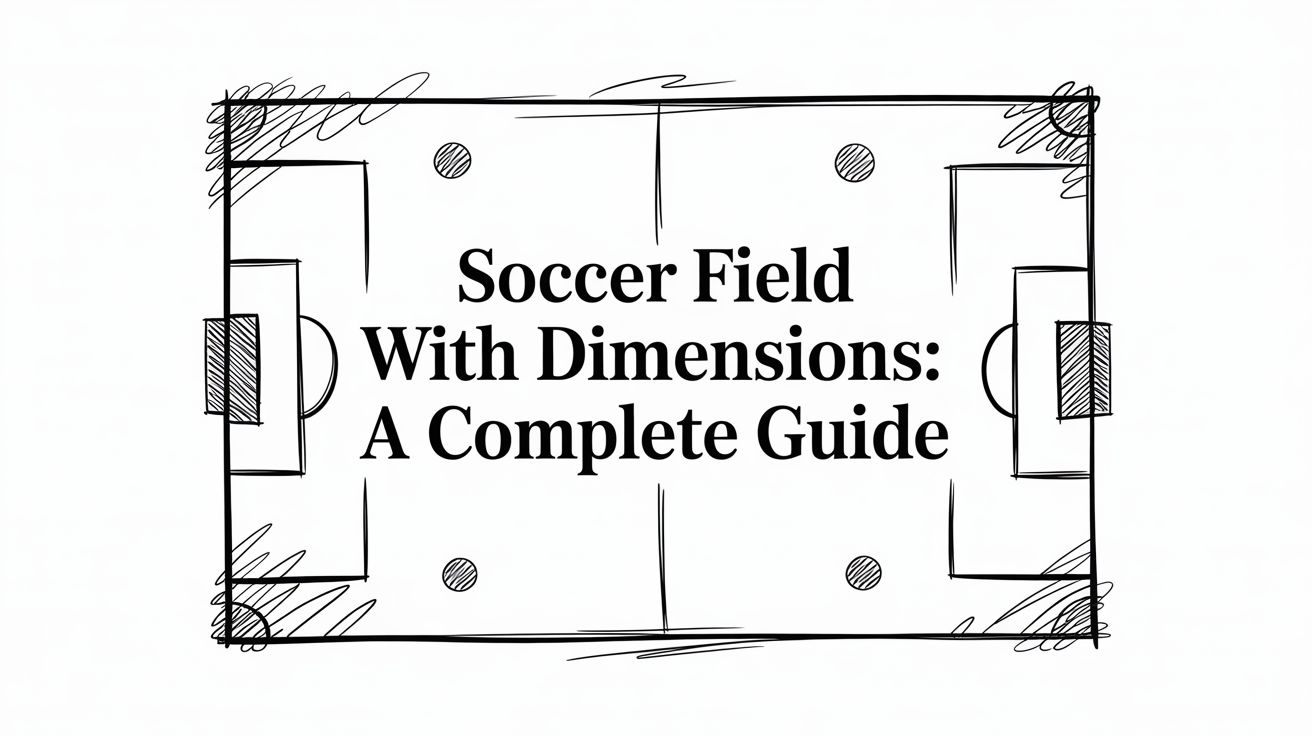
It's a common misconception that every professional soccer pitch is exactly the same size. In reality, the official dimensions fall within a specific range, giving stadiums a bit of unique character. This guide breaks down everything you need to know about a soccer field with dimensions, from professional and international standards to the scaled-down pitches used in youth soccer.
Why This Topic Matters
Understanding the layout and dimensions of a soccer field is crucial for players, coaches, and fans alike. The size of the pitch can dramatically influence game strategy, player positioning, and the overall flow of a match. Knowing the "why" behind each line and boundary marker elevates your appreciation for the beautiful game from a casual observer to an informed enthusiast.
The Official Soccer Field with Dimensions: A Step-by-Step Guide
When you watch a match on TV or step onto a field yourself, it feels like a perfectly defined space. But the truth is, there's a surprising amount of wiggle room in what's considered a regulation pitch. The standards are set by FIFA, the governing body of world soccer, to keep the game fair while accommodating different stadiums.
Step 1: Understanding Standard vs. International Dimensions
For most professional matches, the length of the touchline can be anywhere from 100-130 yards (90-120 meters), and the width of the goal line can span between 50-100 yards (45-90 meters). To ensure global competitions like the World Cup are played on a level playing field, FIFA tightens the rules considerably.
For international matches, the acceptable range shrinks:
- Length (Touchline): Must be between 100 and 110 meters (110 to 120 yards).
- Width (Goal Line): Must be between 64 and 75 meters (70 to 80 yards).
This prevents any team from gaining a massive home-field advantage by playing on an unusually wide or narrow pitch. You can dive deeper into the official soccer field regulations to see all the fine print.
Step 2: Decoding Every Line on the Field
Think of a soccer field as a story told in white lines. Each marking plays a crucial role in the game's flow and rules.
- Halfway Line & Center Circle: The halfway line splits the field into two identical halves. The center circle, with a 10-yard (9.15 meters) radius, ensures a fair kick-off by keeping opposing players at a distance.
- Penalty Area (18-Yard Box): This larger box extends 18 yards (16.5 meters) from the goal line. Inside this area, a goalkeeper can handle the ball, and fouls by the defending team result in a penalty kick.
- Goal Area (6-Yard Box): This smaller box stretches 6 yards (5.5 meters) from the goal line. All goal kicks must be taken from within this area.
- Penalty Arc & Corner Arc: The arc at the top of the penalty area keeps players 10 yards from the ball during a penalty kick. The corner arcs in each of the four corners mark where corner kicks must be taken from.
The gradual evolution of these markings, from the chaotic fields of the 19th century to today's standardized layout, shows how soccer's governing bodies shaped the modern pitch.
Step 3: Adapting the Pitch for Youth Soccer
A full-sized pitch is too large for young players. Youth soccer intentionally scales everything down—fields, goals, and team sizes—to create a better learning environment. This "small-sided games" approach helps children develop skills by increasing their touches on the ball and keeping them engaged.
Tips and Best Practices
Marking a soccer field requires precision. Here are some expert tips to ensure your layout is accurate and professional.
- Use the 3-4-5 Triangle Method: To ensure perfect 90-degree corners, measure 3 units down one line and 4 units down the perpendicular line. The diagonal distance between those two points should be exactly 5 units. This classic geometric trick guarantees your field is a perfect rectangle.
- Always Use String Guides: Don't try to paint lines freehand. Run a tight string between your corner stakes to serve as a guide. This is the secret to getting those perfectly straight, crisp lines you see on professional pitches.
- Choose the Right Paint: Always use a non-toxic, turf-safe field marking paint. This protects both the players and the grass.
- Measure Twice, Paint Once: Double-check all your measurements before applying paint. A small error in the beginning can throw off the entire field's geometry.
Examples of Field Dimensions in Action
The variation in field size is not just theoretical; it has real-world tactical implications.
Case Study: Wide vs. Narrow Pitch: A team like FC Barcelona, known for its possession-based, wide-attacking style, thrives on a pitch at maximum width (around 75 meters). This creates space for wingers to operate and stretches the opponent's defense. In contrast, a team focused on a compact, defensive style might prefer a narrower field to congest play and make it harder for opponents to find space.
Youth Soccer Progression: Here’s how the field grows with the players:
- Under 8 (U8): Plays 4v4 on a tiny field around 25-35 yards long.
- Under 10 (U10): Moves to 7v7 on a field of 55-65 yards long.
- Under 12 (U12): Transitions to 9v9 on a pitch of 70-80 yards long.
- U14 and above: Finally plays the full 11v11 on a standard-sized field.
This gradual increase prepares players physically and technically for the demands of a full-sized game. You can find the perfect place for your team by searching for local soccer fields.
Frequently Asked Questions (FAQ)
Are all professional soccer fields the same size?
No. FIFA and other governing bodies allow for a range of dimensions. For most professional matches, the length can be 100-130 yards and the width 50-100 yards. For international matches, the range is stricter: 110-120 yards long by 70-80 yards wide. This flexibility allows stadiums to have unique characteristics while maintaining competitive fairness.
Why are youth soccer fields so much smaller?
Youth fields are scaled down to match the physical and technical abilities of young players. This "small-sided" approach ensures kids get more touches on the ball, stay more engaged, and develop skills faster in an age-appropriate environment. It makes the game more fun and less physically demanding for growing bodies.
What is the purpose of the center circle?
The center circle has a 10-yard radius and exists to ensure a fair kick-off. When a game starts or restarts after a goal, all players from the defending team must remain outside the circle until the ball is kicked into play. This provides the kicking team with the necessary space to start play without immediate pressure.
How much does field size really affect strategy?
It has a huge impact. A larger, wider pitch creates more space, benefiting teams that rely on speed, long passes, and wing play. Conversely, a smaller, narrower field congests play, favoring teams that excel at short, quick passing or a more physical, defensive style. Home teams often use their specific field dimensions as a key tactical advantage.
What is the penalty arc for?
The penalty arc is the curved line at the edge of the penalty area. Its sole purpose is to ensure all players (except the penalty taker and goalkeeper) remain at least 10 yards away from the penalty spot during a penalty kick. It prevents encroachment and allows the kicker a fair, unimpeded attempt at goal.
Conclusion
The dimensions of a soccer field are more than just lines on the grass; they form the strategic foundation of the game. From the flexible regulations for professional pitches to the carefully scaled-down fields for youth players, every measurement is designed to ensure fairness, promote skill, and enhance the spectacle of the sport. Understanding the layout of a soccer field with dimensions is a fundamental piece of knowledge that deepens appreciation for every match. Looking for a place to play? Explore our list of local soccer fields near you.
Call-to-Action
Ready to find the perfect pitch or create a fun AI video with a soccer superstar? At Soccer Field Map, you can discover and review thousands of local fields or generate a personalized message from your favorite player. Explore Soccer Field Map today to see your local options and create amazing AI soccer videos.