The Ultimate Guide to Soccer Field Dimensions
November 9, 2025

Introduction
Ever noticed how a soccer field's size can feel wildly different from one stadium to the next? Unlike the rigid layouts of American football or basketball, a professional soccer field’s dimensions are surprisingly flexible. In this guide, we'll break down every line, box, and circle on the pitch, from official FIFA regulations for 11v11 matches to the scaled-down fields used in youth soccer, giving you a complete understanding of the beautiful game's blueprint.
Why This Topic Matters
The variability in soccer field dimensions is one of the sport's most interesting quirks and a key part of its global appeal. This flexibility allows the game to be played in countless venues, from local parks to legendary stadiums. For coaches, players, and even fans, understanding these dimensions offers a deeper appreciation for the game's strategy, as the size of the pitch—even within official rules—can dramatically influence tactical formations, player stamina, and the overall style of play.
Step-by-Step Guide to Soccer Field Dimensions
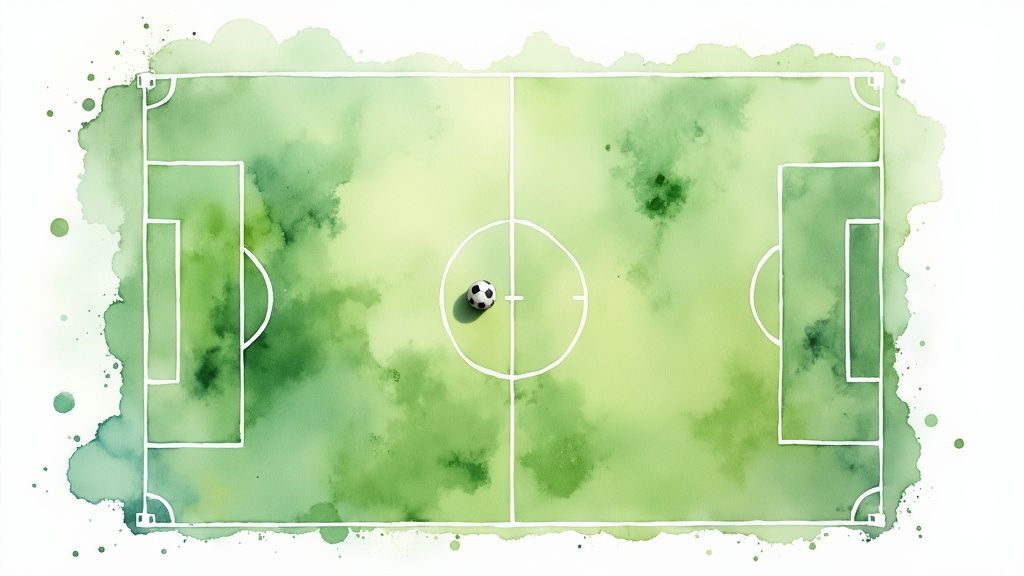
Understanding a soccer field starts with its official regulations and the specific markings that define the game. Here is a full breakdown of the layout for a standard 11v11 pitch.
1. Official FIFA Pitch Regulations
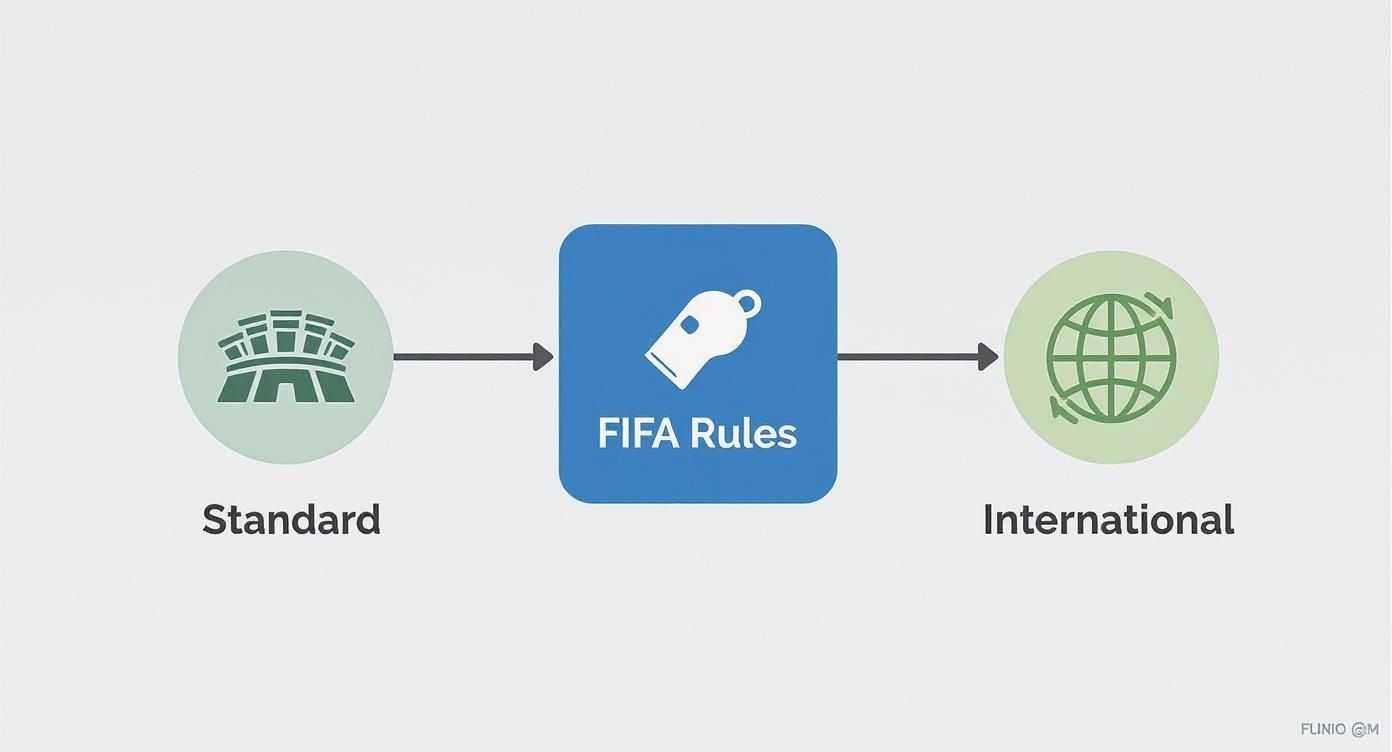
The sport’s governing body, FIFA (Fédération Internationale de Football Association), outlines acceptable dimensions in its Laws of the Game. This rulebook differentiates between standard and international matches to ensure fairness at the highest levels.
- Standard Match Dimensions: For most professional and amateur games, the rules allow for a generous range. The length (touchline) must be between 90 and 120 meters (100 to 130 yards), and the width (goal line) must be between 45 and 90 meters (50 to 100 yards).
- International Match Dimensions: When national teams compete in tournaments like the World Cup, the rules become much stricter to create a level playing field. The length must be between 100 and 110 meters (110 to 120 yards), and the width must be between 64 and 75 meters (70 to 80 yards).
This infographic is a great visual for how FIFA’s rules for standard pitches differ from the much stricter requirements for international competitions.
2. Key Field Markings Explained
Every line on the pitch serves a purpose, creating a map that players and officials follow.
- Center Mark and Center Circle: The game starts and restarts at the center mark. The surrounding center circle has a 10-yard (9.15-meter) radius, and opposing players must stay outside it during a kickoff.
- The Goal Area (6-Yard Box): This smaller box extends 6 yards (5.5 meters) from the goal line. Goal kicks can be taken from anywhere within this area.
- The Penalty Area (18-Yard Box): The larger box stretches 18 yards (16.5 meters) from the goal line. Inside this area, the goalkeeper can use their hands, and defensive fouls result in a penalty kick.
- The Penalty Mark and Arc: The penalty mark is exactly 12 yards (11 meters) from the goal line. The attached penalty arc ensures all other players remain 10 yards (9.15 meters) away during a penalty kick.
- Corner Arcs: Each corner has a 1-yard (1-meter) radius arc where the ball must be placed for a corner kick.
- Goal Dimensions: A standard, full-size goal is 8 yards (7.32 meters) wide and 8 feet (2.44 meters) high.
For professional groundskeepers needing absolute precision, modern tech like drones with LiDAR for 3D mapping has become an essential tool. These regulations are just as crucial for indoor soccer fields, which have their own unique layouts.
3. Youth Soccer Field Variations
Youth soccer wisely uses scaled-down fields that grow with the players to ensure more engagement and skill development.
- U6-U8 (4v4 format): Fields are 25-35 yards long by 15-25 yards wide.
- U9-U10 (7v7 format): Fields grow to 55-65 yards long by 35-45 yards wide.
- U11-U12 (9v9 format): Fields are nearly full-size at 70-80 yards long by 45-55 yards wide.
Tips, Best Practices, and Common Mistakes
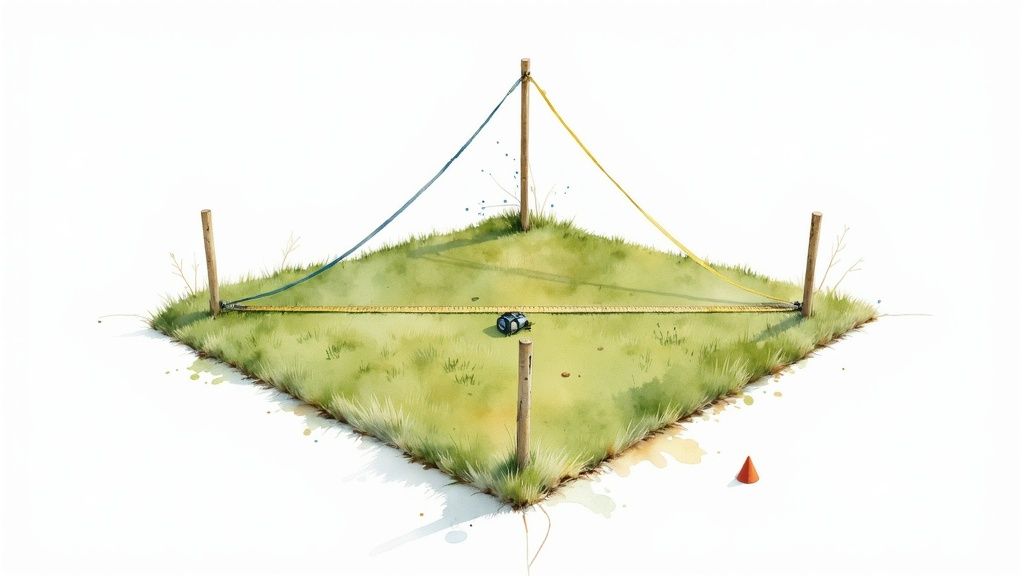
Marking a field accurately is crucial for fairness and compliance. Here are common mistakes to avoid and best practices to follow.
- Mistake: Ignoring Square Corners. The most common error is failing to create a perfect 90-degree angle. Best Practice: Use the 3-4-5 triangle method. Measure 3 units down one line and 4 units across the other; the diagonal between them must be 5 units. If not, your corner isn't square.
- Mistake: Inconsistent Line Measurement. FIFA requires all lines to be the same width (max 5 inches) and measured from the outside edge. Measuring from the center or inside will make your zones smaller than regulation.
- Mistake: Misplacing Key Markings. Tiny errors on the penalty spot can cause big arguments. Best Practice: Double-check that the penalty mark is exactly 12 yards from the goal line and that the penalty arc has a 10-yard radius from the spot.
Following these tips ensures a professional and regulation-compliant pitch. To learn more about how rules have evolved, you can discover more about the history of soccer field sizes.
Examples of Field Dimensions in Pro Leagues
While FIFA sets the rules, professional leagues and stadiums interpret them with fascinating results, creating a tactical home-field advantage.
- The "Gold Standard" Pitch: Many top European clubs, particularly in the German Bundesliga, use a pitch size of 105 meters long by 68 meters wide (115 x 74 yards). This size is seen as a benchmark for balanced, competitive play. You can check out the official Bundesliga pitch requirements for more details.
- Wider Pitch Advantage (e.g., Camp Nou): A wider field benefits possession-based teams that use wingers and switch the point of attack. It stretches the opposing defense, creating passing lanes for creative playmakers.
- Narrower Pitch Advantage: A narrower, more compact field favors teams that rely on a high press, direct long balls, and physical play. It congests the space, forcing turnovers and quick counter-attacks.
These subtle variations are a key strategic element in professional soccer. For a deep dive into North American stadiums, explore our guide on every MLS soccer field's dimensions. You can also see how fields vary by exploring how soccer field sizes can vary or visiting a facility like the Kansas State Youth Soccer Association complex.
FAQ
1. Are all professional soccer fields the same size?
No. While many top leagues prefer a standard size (around 105 x 68 meters), FIFA's rules allow for a range in both length and width. This means dimensions can vary slightly from one stadium to another, even at the highest level of the sport.
2. What are the dimensions of a high school soccer field?
In the U.S., the National Federation of State High School Associations (NFHS) recommends a length between 100 and 120 yards and a width between 55 and 80 yards. This range fits comfortably within FIFA’s general regulations for a standard, non-international pitch.
3. Does the size of the field actually affect the game?
Absolutely. A wider field benefits possession-based, tactical teams by creating more space. A narrower field creates congestion, favoring teams that rely on high-pressing, direct play, and physical strength. Home teams often use their pitch dimensions as a strategic advantage.
4. What is the smallest official soccer field size for 11v11?
For a standard 11v11 adult match, the smallest pitch allowed by FIFA is 100 yards (90 meters) long and 50 yards (45 meters) wide. Anything smaller is considered non-regulation for a full-sided game.
5. Why do soccer field dimensions vary?
The variation dates back to the sport's origins, when rules were made flexible to accommodate play in various spaces like public parks. While professional leagues now strive for more uniformity, the official rulebook still honors this heritage of adaptability, which helped soccer spread globally.
Conclusion
From the flexible FIFA regulations for an 11v11 pitch to the scaled-down fields essential for youth development, soccer field dimensions are a core element of the game's strategy and global appeal. Understanding the blueprint of the pitch—including every line, box, and arc—gives you a deeper appreciation for the tactical nuances that unfold during a match. Whether you're marking a field for the first time or analyzing your favorite team's home-field advantage, these dimensions are the foundation of the beautiful game.
Call-to-Action
Ready to find a pitch near you or show off your local field? Use our tools to find a soccer field near you or add a new field to our database. At Soccer Field Map, our goal is to help you connect with the game you love. Discover more on our platform!