A Guide to the Modern Soccer Field and Pitch Setup
November 6, 2025
Introduction
Welcome to the definitive guide on the modern soccer field and all its essential parts. Truly understanding the pitch—from its official dimensions and markings to the playing surfaces that dictate every pass—is the first step to appreciating the beautiful game on a deeper level. This guide breaks down what it takes to turn a simple patch of grass into a professional-grade pitch.
Why This Topic Matters
Whether you're a coach, a player, or a dedicated fan, knowing the field inside and out completely changes how you see the game. The layout isn't just a random set of lines; it’s the strategic blueprint for every match. A great game depends on a well-designed soccer field and the facility around it, making this knowledge crucial for appreciating the sport's tactical nuances. A great place to start is by exploring our community's firsthand soccer field reviews to see how these elements come to life at parks and stadiums near you.
Deconstructing the Soccer Pitch and Its Markings
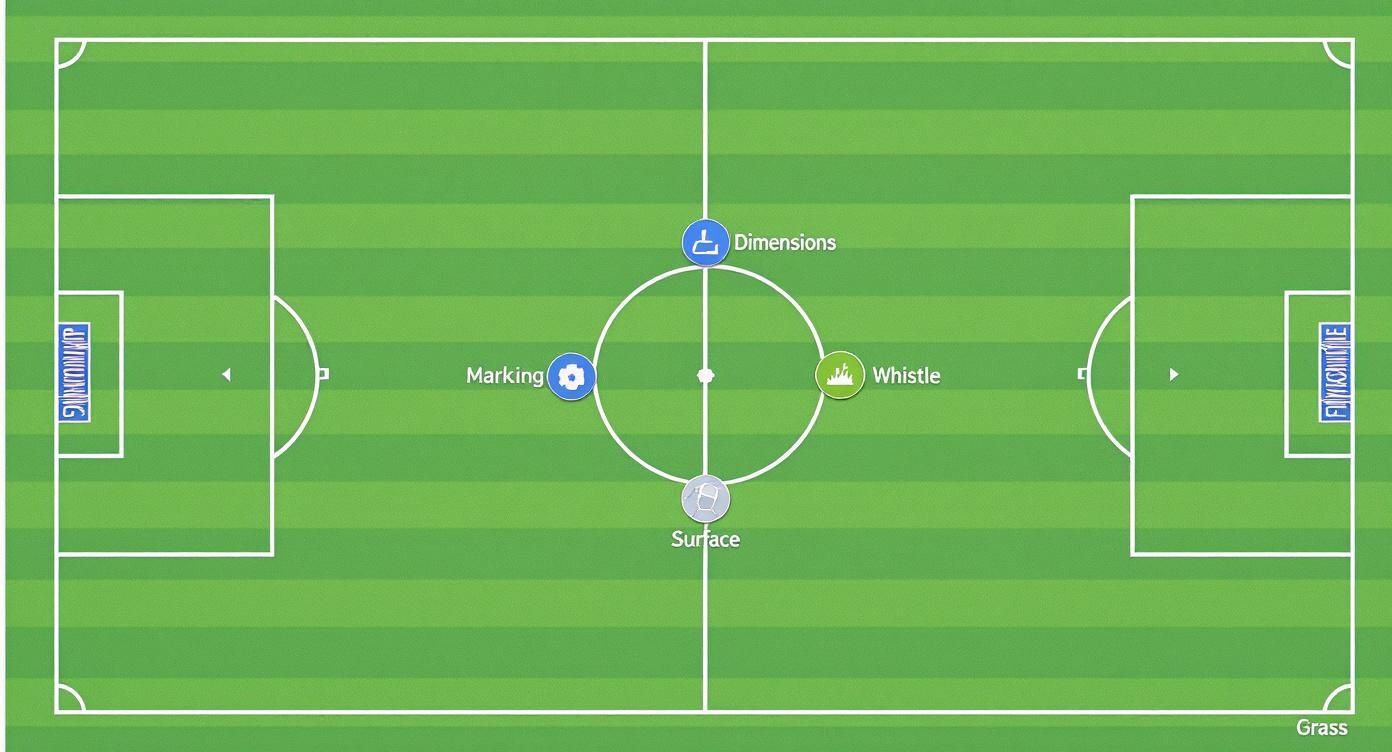
Every line on a soccer field tells a story. Think of these markings not just as paint on the grass, but as the silent rules that govern the beautiful game's flow. From the halfway line to the corner arc, each boundary is a piece of a much larger strategic puzzle, dictating everything from defensive discipline to how play restarts.
When you understand this layout, you start to see the soccer field and its possibilities through a coach's eyes. The penalty area, for example, is more than just the spot where fouls turn into penalty kicks. It’s a high-stakes zone that forces defenders to be surgically precise and attackers to get ruthlessly creative. Likewise, the goal area (often called the "six-yard box") defines where goal kicks are taken and gives the goalkeeper a little extra protection. Every line shapes a player's split-second decisions.
This infographic breaks down the core components that make up a modern soccer pitch.
Step 1: Understanding Official Field Dimensions
While the pitch at your local park might have its own unique quirks, professional fields follow some pretty strict guidelines. FIFA, the sport’s international governing body, regulates the length and width to keep competition fair and consistent. For international matches, a field has to be between 100–110 meters (110–120 yards) long and 64–75 meters (70–80 yards) wide.
These dimensions weren't always so set in stone. When the first rules were drafted back in 1863, field sizes were all over the place. In fact, the average area of top-tier European pitches grew by nearly 10% between 1990 and 2020. This shift directly influenced tactics by giving teams more room for wide play and lightning-fast counter-attacks. You can dive deeper into the history of soccer field sizes on si.com. It’s a great example of how even the ground beneath the players’ feet evolves with the game.
Step 2: Key Soccer Field Markings and Their Purpose
To make sense of it all, here's a quick rundown of the essential markings you'll find on any standard pitch. These lines aren't just for decoration; they are the very language of the game, understood by players, referees, and fans alike.
- Touchline: The side boundary of the field. When the ball crosses it, a throw-in is awarded.
- Goal Line: The end boundary of the field. A goal is scored when the ball fully crosses this line between the posts.
- Halfway Line: Divides the field into two equal halves. Play is restarted from the center of this line.
- Center Circle: A 10-yard radius around the center mark. Opponents must stay outside it during a kickoff.
- Penalty Area: A foul by the defending team inside this box results in a penalty kick.
- Goal Area: The smaller "six-yard box" where goal kicks are taken from.
- Penalty Arc: The arc at the edge of the penalty area. Players must stay behind it during a penalty kick.
- Corner Arc: A one-yard quarter-circle where the ball is placed for a corner kick.
Step 3: How Playing Surfaces Impact the Game
The ground beneath a player's feet is a total game-changer, influencing everything from the speed of the ball to the safety of the players. A pristine grass soccer field with a perfectly manicured surface allows for a fast, crisp passing game. On the flip side, artificial turf often produces a higher, more predictable bounce, which completely changes how players have to control the ball.
Every surface brings its own unique set of challenges and advantages. The type of playing ground directly impacts team strategy, how skills are executed, and even the risk of injury. Getting a feel for these differences is crucial for any player or coach who wants to adapt and win in different environments.

- Natural Grass Pitches: Natural grass is the traditionalist's choice, loved for its authentic feel and incredible shock absorption. But let's be honest, its quality depends heavily on maintenance and the local climate. To keep a natural grass field in top shape, effective aeration and overseeding techniques are non-negotiable for turf health and resilience.
- Artificial and Hybrid Surfaces: Artificial turf, especially the modern 3G (third-generation) surfaces, offers durability and consistency that grass just can't match. It can handle heavy use and all kinds of weather. Hybrid systems, which weave synthetic fibers into natural grass, aim to give you the best of both worlds. These same factors come into play when you're looking at indoor soccer fields, where a consistent surface is an absolute must.
Step 4: The Strategic Impact of Field Dimensions
While FIFA sets a standard range for field dimensions, not all professional pitches are created equal. These subtle differences in length and width can create powerful tactical advantages, turning the soccer field and its layout into another player on the team. A club’s home pitch is often tailored to amplify its strengths.
- Wide Fields: A wide field is a playground for speed. Teams with fast wingers can use all that extra space to stretch the opposition's defense thin and isolate defenders.
- Narrow Fields: On the flip side, a narrower field is a huge plus for teams that play a compact, defensively organized style. Less width makes it far easier to press opponents and choke off passing lanes.
Step 5: Beyond the Pitch: Essential Facility Amenities
A great soccer experience goes way beyond the touchlines. The quality of a soccer field and its surrounding facility can make or break a game day for players, families, and fans. These features aren't just nice-to-haves; they're critical for safety, comfort, and creating an environment where the sport can thrive.
- Dedicated Warm-Up Areas: A separate, safe space for teams to stretch and run drills.
- Comfortable Spectator Seating: Bleachers or designated seating areas with unobstructed views.
- Well-Maintained Changing Rooms & Restrooms: Clean, secure spaces are fundamental for any quality facility.
- Quality Lighting & Ample Parking: These are must-haves for safety and convenience, especially for evening games.
Tips and Best Practices
- Tailor Tactics to the Pitch: A team’s home field is more than just grass and lines; it’s a strategic asset. The dimensions are often a deliberate choice to force visiting teams out of their comfort zone and into a style of play that favors the home side.
- Understand the Surface Advantage: A fast turf pitch can favor a counter-attacking team, while a slower, softer grass field might benefit a team that relies on possession and intricate passing. Always adapt your playstyle.
- Scout the Whole Facility: When looking for a home field, evaluate off-the-pitch factors like parking and restrooms just as carefully as the turf itself. The best venues invest in the details that support players and the community. You can explore a curated list of the best soccer fields to see how top-rated facilities blend excellent pitches with outstanding amenities.
Example: A Professional Team's Home Field Advantage
Consider a professional team known for its high-pressing, aggressive defensive style. They might maintain their home soccer field and its dimensions to be on the narrower side of the official regulations. This compact space makes it easier for their players to close down opponents, limit passing options, and create turnovers in the midfield. Visiting teams, especially those who rely on wide wingers, will find their usual game plan stifled, giving the home team a significant tactical edge before the match even begins. This is a real-world application of how field dimensions directly influence game strategy. You can explore the unique dimensions of different stadiums, like those in our guide to MLS fields, to see exactly how top clubs build their own custom fortresses.
FAQ: Common Questions About Soccer Fields
Are all professional soccer fields the same size?
No, they are not. While professional fields must fall within a specific range set by governing bodies like FIFA (typically 100-110 meters long and 64-75 meters wide for international matches), clubs can customize their pitch size within these limits. This variation allows teams to create a home-field advantage tailored to their specific style of play.
What is the main difference between natural grass and modern turf?
The primary differences lie in maintenance, playability, and feel. Natural grass offers superior shock absorption and a traditional ball roll but requires significant upkeep and is susceptible to weather damage. Modern artificial turf is highly durable, weather-resistant, and consistent, but the ball may bounce higher and faster, and the surface can get hot.
Why are youth soccer fields smaller?
Youth fields are scaled down to match the physical and developmental stage of young players. A smaller playing area ensures kids get more touches on the ball, stay more involved in the game, and have more opportunities to dribble, pass, and shoot. This approach prioritizes skill development and fun, with field sizes increasing as players grow older and stronger.
Conclusion
Knowing the ins and outs of a soccer field gives you a real strategic edge. It’s not just about kicking a ball around; it's about understanding how every detail—from the dimensions influencing tactics to the surface dictating play speed—shapes the game. The perfect pitch is more than just grass and goals—it's the very foundation of great soccer.
Call-to-Action
Now that you're equipped to appreciate every inch of the pitch, it's time to put that knowledge to use. Ready to explore the best fields in your area? Use our tools to find a soccer field near you for your next game. Or, visit Soccer Field Map & AI Soccer Videos at https://soccerfieldmap.com/ to start your journey.