Your Ultimate Guide to the Soccer Field
November 3, 2025

More than just a patch of grass, a soccer field is the stage where the beautiful game comes to life. It’s a carefully measured arena where strategy, skill, and athleticism collide. This guide will break down every line, circle, and dimension, explaining how the pitch itself shapes the game from kickoff to the final whistle.
Why This Topic Matters
A soccer field is far more than just a playing surface; it’s the canvas where every pass, tackle, and strategic decision comes to life. For players, understanding the pitch is crucial for top performance. A wide field creates space for wingers, while a narrow one favors a high-pressing team. The surface—be it natural grass or artificial turf—dictates ball roll, bounce, and player movement, impacting everything from passing accuracy to injury risk. For coaches and fans, grasping these nuances adds a whole new layer of appreciation for the beautiful game.
The Official Soccer Field: A Step-by-Step Breakdown
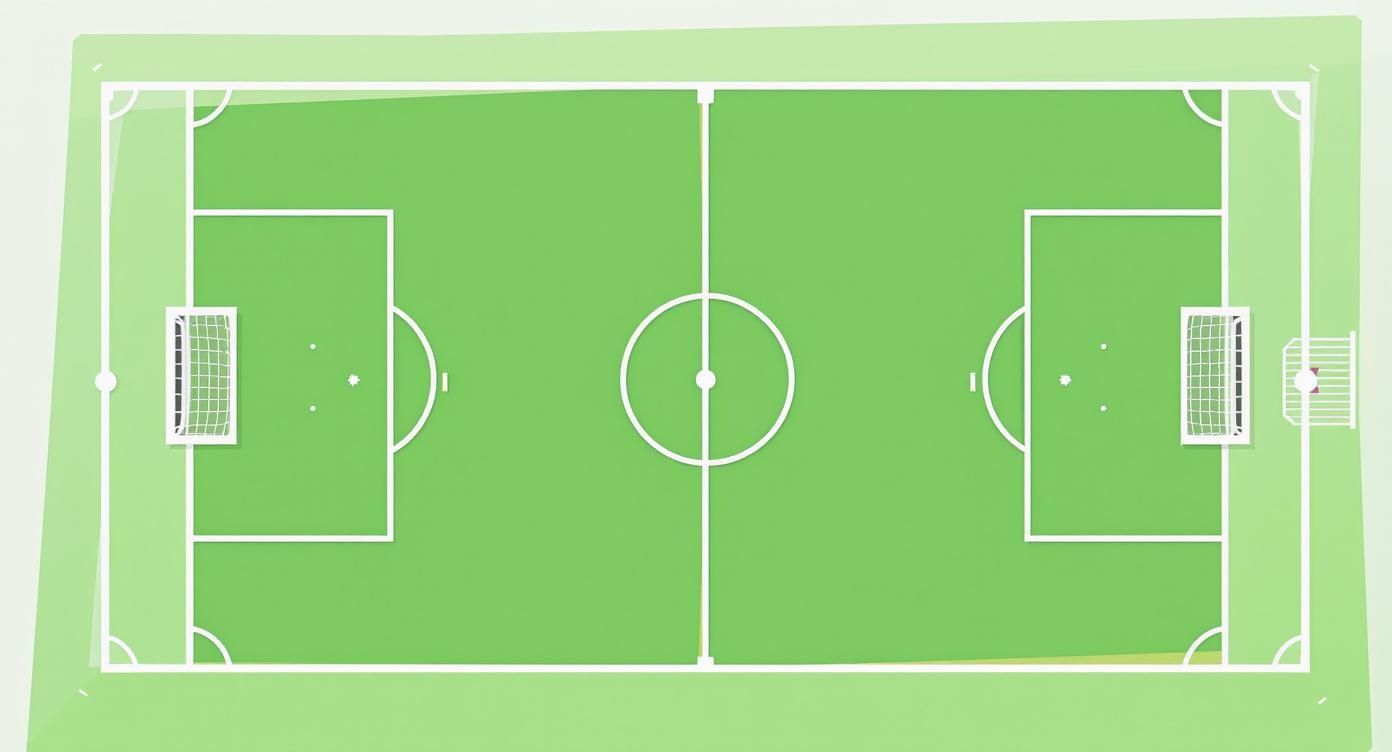
To truly understand soccer strategy, you must first understand the field. Every soccer field is a carefully designed space where each line and arc dictates the rules, shapes the flow of the game, and sets the stage for tactical genius.
Step 1: Understanding the Dimensions
It's a common myth that every pro soccer field is one standard size. In reality, the Fédération Internationale de Football Association (FIFA) provides a range for dimensions, which has a huge tactical impact. A team built around speedy wingers might prefer a wider field, while a team that thrives on a suffocating defense would feel right at home on a narrower pitch.
Here’s a quick breakdown of the official FIFA regulations:
| Official FIFA Soccer Field Dimensions | ||
|---|---|---|
| Dimension | Standard Matches (Yards/Meters) | International Matches (Yards/Meters) |
| Length (Touchline) | 100-130 yards / 90-120 meters | 110-120 yards / 100-110 meters |
| Width (Goal Line) | 50-100 yards / 45-90 meters | 70-80 yards / 64-75 meters |
The dimensions for international matches are stricter to ensure a consistent, level playing field for teams from different leagues and countries.
Step 2: Decoding the Key Markings
Every line on the pitch serves a purpose, governing everything from kick-offs to penalty shots.
- Touchlines and Goal Lines: These are the long and short boundary lines. When the ball crosses a touchline, play restarts with a throw-in. If it crosses the goal line, it results in a goal kick or a corner kick.
- The Halfway Line and Center Circle: The halfway line divides the field into two halves. The game starts at the center mark, located inside a 10-yard radius circle where opposing players cannot enter until the ball is in play.
- The Penalty Area (18-yard box): This is a critical zone. If a defender commits a direct free-kick foul here, the opposing team is awarded a penalty kick. This is also the only area where the goalkeeper can legally use their hands.
- The Goal Area (6-yard box): The smaller box inside the penalty area. Goal kicks must be taken from within this area.
- The Penalty Arc: This arc at the top of the penalty area ensures all players (except the taker) remain at least 10 yards away from the ball during a penalty kick.
- The Corner Arc: A small quarter-circle with a 1-yard radius at each corner. The ball must be placed inside this arc for a corner kick. For a deep dive, check out this guide on understanding the significance of corner kicks.
Tips and Best Practices
Whether you're playing, coaching, or just watching, understanding the pitch's nuances can give you an edge.
- Assess the Surface: Before a match, walk the field. Is the grass long or short? Is the turf fast? A slick, wet surface speeds up the ball, favoring a quick passing game. A dry, slow pitch might call for more direct, aerial play.
- Use the Full Width: If your team has fast wingers, encourage them to stay wide. Stretching the opposition's defense horizontally creates gaps in the middle for your attackers to exploit.
- Know Your Home Field: If you play regularly on the same pitch, learn its quirks. Are there uneven patches? Does one side drain better than the other? This "insider knowledge" is a key part of home-field advantage.
- Consider the Surface Type: Remember the difference between playing surfaces. On indoor soccer fields or artificial turf, the ball will roll faster and bounce higher than on natural grass. Adjust your first touch and passing weight accordingly.
Case Study: How Stoke City Used Field Size as a Weapon
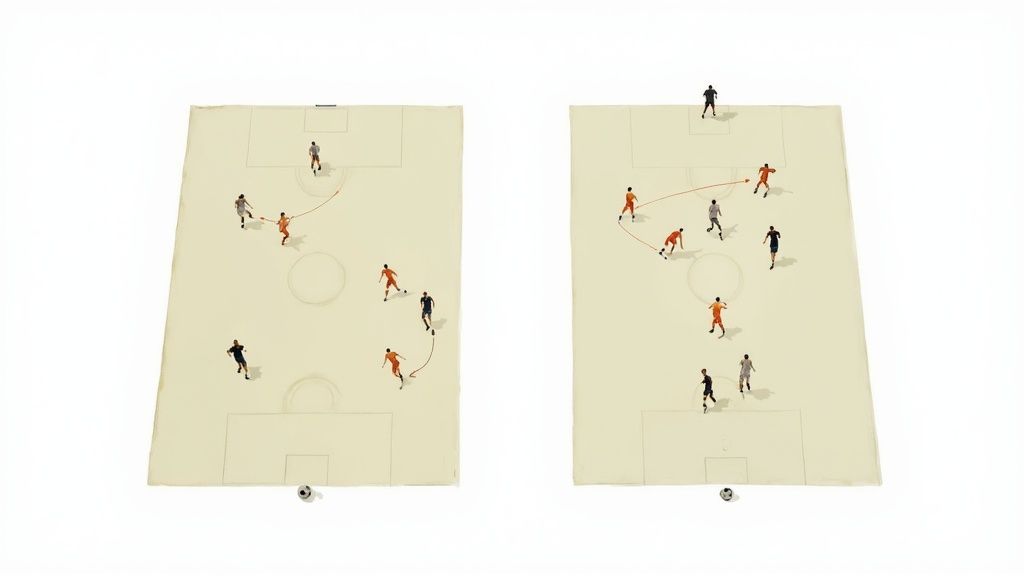
A perfect example of leveraging field dimensions for a tactical advantage comes from Stoke City's 2008-09 Premier League season. Known for their physical, direct style of play, they famously narrowed their home pitch to 100 meters by 64 meters—the minimum width allowed.
This small tweak had a massive impact. The narrow soccer field congested the playing area, making it difficult for more technical, possession-based teams to find space. It perfectly suited Stoke's high-pressure tactics and long-throw-in strategy. The result? They won an impressive 10 of their 19 home matches that year, a crucial factor in their survival in the top flight. This demonstrates that the pitch is not just a backdrop but a dynamic tool in a team's tactical arsenal.
FAQ: Common Soccer Field Questions
Here are answers to some of the most frequently asked questions about the pitch.
1. Are all professional soccer fields the same size?
No. While international match fields have strict dimensions (around 110-120 yards long by 70-80 yards wide), domestic league rules often allow for a range. This means a team's home soccer field can be wider or narrower to suit their playing style, creating a subtle home-field advantage.
2. What's the difference between natural grass and artificial turf?
Natural grass is preferred by most professionals for its true ball roll and softer impact, which can be safer on joints. However, it requires significant maintenance. Artificial turf is far more durable, can be used in all weather, and has lower upkeep costs. The debate continues, but you can learn more about artificial turf vs natural grass.
3. Why do soccer fields have patterns in the grass?
The stripes and checkerboard patterns are purely for aesthetics and have no impact on gameplay. Groundskeepers create them by using a mower with a roller, which bends the grass blades in different directions. Blades bent toward you reflect more light and appear lighter, while blades bent away appear darker.
4. What are the dimensions of a youth soccer field?
Youth fields are scaled down to match the players' age and the game format (4v4, 7v7, 9v9). For example, a field for 6-8-year-olds (U8) might be just 25-35 yards long, while one for 11-12-year-olds (U12) could be 70-80 yards long, preparing them for a full-sized pitch.
5. How have soccer fields changed over time?
Early soccer fields were often poorly marked with inconsistent sizes. Over the last century, governing bodies like FIFA have standardized dimensions and markings. Lines for the penalty area (1902) and rules standardizing international pitch sizes (first in 1937, updated since) were introduced to ensure fairness and consistency as the game became a global sport. You can read more on the history at Evertise.net.
Conclusion
A soccer field is much more than a playing area; it’s an integral part of the game’s strategy and beauty. From the specific dimensions that create a home-field advantage to the distinct characteristics of grass and turf, every element influences the match. Understanding the layout of the pitch, the purpose of each marking, and how it all comes together will deepen your appreciation for soccer, whether you’re a player, coach, or fan.
Call to Action
Ready to find the perfect pitch for your next game? With Soccer Field Map, you can instantly discover and get directions to thousands of fields in your area. Stop searching and start playing. Explore the best soccer fields near you today!