Football Field Dimensions Soccer Explained
November 27, 2025

Introduction
Ever noticed how some professional soccer pitches feel wider or longer than others? You’re not imagining it. While the beautiful game is played on a rectangular canvas, its measurements are surprisingly flexible. This guide breaks down the official football field dimensions for soccer, from FIFA's international standards to the scaled-down pitches used in youth leagues, explaining how these numbers shape the game.
Why This Topic Matters
Understanding football field dimensions for soccer is crucial for more than just trivia; it directly impacts the game's strategy, pace, and physical demands. For coaches, the size of the pitch dictates tactical approaches, favoring either expansive, possession-based play or a compact, high-pressure system. For players, it determines fitness requirements and positional duties, while for fans, it offers a deeper appreciation for the tactical nuances that define every match. The dimensions are the invisible architecture of the game, quietly influencing every pass, run, and goal.
A Guide to Official Soccer Field Dimensions
Believe it or not, there isn't one single, universal size for a soccer field. Instead, governing bodies like FIFA provide an approved range for length and width. This allows pitches to vary slightly from one stadium to the next, making the game adaptable while keeping things fair.
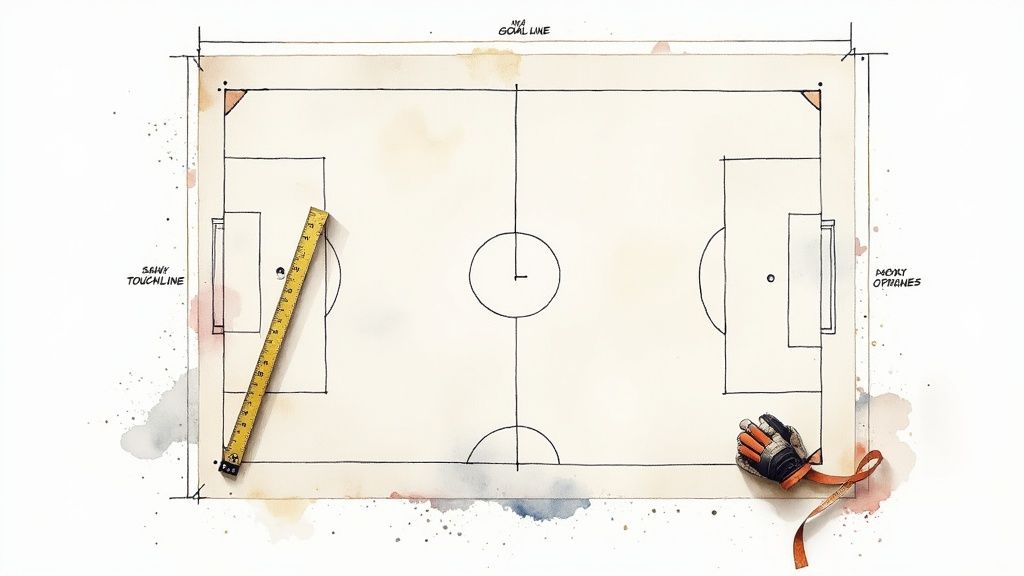
The Official Size Range and Markings
While the ideal, most commonly cited size is 115 yards long by 74 yards wide (105 by 68 meters), the official rules allow for quite a bit of wiggle room. For most competitive matches, the touchlines (length) can fall anywhere between 100 and 130 yards, and the goal lines (width) can span from 50 to 100 yards.
- Halfway Line & Center Circle: The halfway line divides the pitch in two. The center circle has a 10-yard radius from the center mark, where kick-offs occur.
- Penalty Area (18-Yard Box): This critical zone measures 18 yards from the goal line and 44 yards wide. The goalkeeper can handle the ball here, and defensive fouls result in a penalty kick.
- Goal Area (6-Yard Box): A smaller box inside the penalty area, it extends 6 yards from the goal line and is 20 yards wide. Goal kicks are taken from within this area.
- Penalty Mark & Arc: The penalty spot is exactly 12 yards from the goal line. The arc outside the penalty area ensures players remain 10 yards away during a penalty kick.
- Corner Arcs: A 1-yard radius quarter-circle in each corner marks where corner kicks must be taken.
Stricter Rules for International Play
When the stakes get higher for international competitions like the World Cup, the rules tighten up. For these elite matches, the dimensions are more constrained to ensure consistency:
- Length (Touchline): Must be between 110 and 120 yards.
- Width (Goal Line): Must be between 70 and 80 yards.
This narrower range guarantees that teams compete on similarly sized fields, removing any major home-field advantage from an unusually large or small pitch. Modern tools like drone operations transforming land surveying have made marking these massive fields incredibly precise.
Tips, Best Practices, & Common Mistakes
Marking a field requires precision, as small errors can create unfair advantages. Knowing common mistakes is the first step to creating a professional, rule-compliant playing surface.

Common Mistakes to Avoid:
- Forgetting to Square the Corners: The most frequent error is failing to create perfect 90-degree angles. Use the 3-4-5 triangle method to ensure a true rectangle. Measure 3 units down one line and 4 units down the intersecting line; the diagonal between these points must be exactly 5 units.
- Miscalculating Critical Distances: The penalty spot (12 yards from the goal line), the penalty arc (10-yard radius from the spot), and corner arcs (1-yard radius) must be exact. Inaccuracy here can lead to disputes.
- Inconsistent Line Width: All lines on the pitch must be the same width, not exceeding 5 inches (12 cm). Uneven lines look unprofessional and can create ambiguity for referees on close calls.
Best Practices:
- Double-Check Measurements: Always measure twice before painting.
- Use Proper Tools: A good quality line marker, measuring tapes, and stakes are essential for accuracy.
- Start with a Baseline: Establish one touchline perfectly straight and square everything else off of it.
Examples of Field Dimensions in Action
The specific football field dimensions soccer teams play on directly shape team strategy, tax player fitness, and ultimately define the style of play.
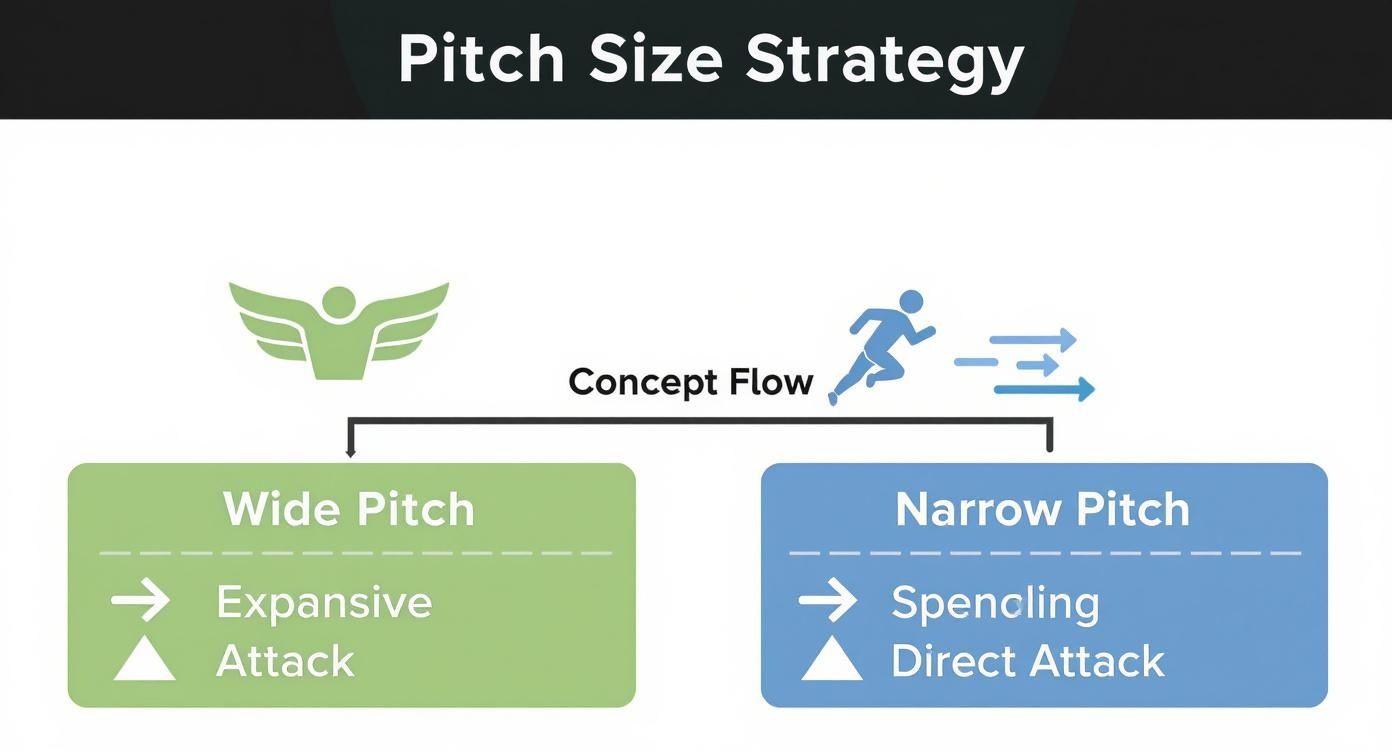
Case Study 1: The Expansive Pitch (Wide Field)
A larger, wider field is an open canvas perfect for teams that thrive on a possession-based, fluid passing game. All that extra real estate becomes a playground for talented wingers who can stretch the opponent's defense thin, creating gaps for midfielders and forwards to exploit. Playing on these bigger surfaces also demands higher stamina, as players cover more ground. This is why some of the best soccer fields are celebrated for their dimensions that encourage beautiful, attacking football.
Case Study 2: The Compact Pitch (Narrow Field)
On the flip side, a narrower, shorter pitch creates a congested, compact game. This is a huge advantage for teams that love high-pressure tactics, quick transitions, and direct, vertical attacks. With less space, defenders can close down attackers quickly, leading to a faster, more physical brand of soccer.
On a smaller pitch, the game’s tempo naturally speeds up. The ball travels from defense to attack in just a few passes, rewarding teams that can launch a lightning-fast counter-attack.
Example: Youth Soccer Dimensions
Youth soccer organizations scale down field dimensions to match players' physical and technical abilities. This smart approach ensures more touches on the ball, which is critical for skill development.
- U6-U8 (4v4): Play on tiny fields of 25-35 yards long by 15-25 yards wide.
- U9-U10 (7v7): Move up to pitches of 55-65 yards by 35-45 yards.
- U13+ (11v11): Transition to nearly full-size fields of 100-110 yards by 60-70 yards.
This progression, seen at facilities like the Utah Youth Soccer Association complex, allows the game to grow with the players. For more on how professional dimensions compare, you can see how these dimensions adapt on SI.com. Reading various soccer field reviews can also give you a feel for how different pitches are rated by players.
FAQ
1. Are all professional soccer fields the same size?
No. While many top stadiums use FIFA's recommended size of 115 by 74 yards, the official rules for international matches allow for a range: 110-120 yards in length and 70-80 yards in width. This flexibility means home fields can have their own distinct feel and create a tactical advantage.
2. What is the difference between a football and soccer field?
An American football field has fixed, standardized dimensions: 120 yards long (including end zones) and 53 1/3 yards wide. A soccer field is almost always wider and has a flexible size range. The markings are also completely different, with a soccer pitch featuring a center circle and penalty areas, while a football field has yard lines and hash marks.
3. How big is the penalty box in soccer?
The penalty area (or "18-yard box") has exact measurements that never change. It extends 18 yards from the goal line and is 44 yards wide. The smaller goal area ("6-yard box") inside it is 6 yards out and 20 yards wide. The penalty spot is precisely 12 yards from the center of the goal.
4. Why are youth soccer fields smaller?
Youth fields are scaled down to match the physical and developmental stage of young players. A smaller field increases ball touches for each child, which is crucial for building fundamental skills like dribbling, passing, and shooting. It keeps kids engaged, builds confidence, and ensures the game is about skill, not just running over a massive space.
Conclusion
The dimensions of a soccer field are far more than just lines on the grass; they are a fundamental part of the game's architecture. From the flexible regulations of professional pitches that allow for strategic home-field advantages to the thoughtfully scaled-down fields that nurture young talent, every yard matters. Understanding these measurements provides a deeper insight into the tactical chess match on the field and enhances appreciation for the sport. If you're inspired to contribute to the community, you can help by helping to add a new field to public databases with verified, accurate info.
Take the Next Step
Ready to explore the best pitches near you or create a fun, personalized video message from a soccer superstar? At Soccer Field Map, we bring the game to life both on and off the field. Discover thousands of fields and generate unique AI soccer videos today!