A Complete Guide to the Field in Soccer
November 21, 2025
Introduction
Ever wondered what all those lines on a soccer pitch actually mean? A field in soccer is far more than just a patch of grass; it's the strategic blueprint for every match, a carefully measured grid that dictates the rules, tactics, and flow of the beautiful game. This guide will break down everything you need to know, from official dimensions to how the layout influences game-winning strategies.
Why This Topic Matters
Understanding the layout of a soccer field transforms how you watch, play, and coach the game. For fans, it clarifies the rules and reveals the tactical battles unfolding on the pitch. For players and coaches, mastering the zones and lines is fundamental to smart positioning, effective plays, and ultimately, winning matches. Once you see the field as a tactical map, you unlock a deeper appreciation for the deliberate design behind the world's most popular sport.
Step-by-Step Guide to the Soccer Field
Step 1: Decoding the Dimensions and Markings
At first glance, a soccer field might just look like a big rectangle of grass. But for players, every single line out there tells a story and dictates the rules of the game. According to FIFA, a regulation field needs to be between 100 and 130 yards long and 50 to 100 yards wide. International matches have stricter rules to keep things consistent, requiring a length of 110-120 yards and a width of 70-80 yards.
- Touchlines and Goal Lines: These are your basic boundaries. The long lines on the sides are the touchlines (sidelines), and the shorter ones at each end are the goal lines.
- Halfway Line and Center Circle: The halfway line splits the field in two. The center circle has a 10-yard radius and is used to keep opposing players at a distance during kick-offs.
- The Penalty Area: Often called the "18-yard box," this is the large rectangle in front of the goal. If a defender commits a foul inside this box, it results in a penalty kick. This is also the only area where the goalkeeper can legally use their hands.
- The Goal Area: This smaller box within the penalty area is the "6-yard box." Goal kicks are taken from within this area.
- The Corner Arc: A small quarter-circle in each of the four corners of the field. The ball must be placed within this arc for a corner kick.
Step 2: Understanding How Field Zones Influence Strategy
To a coach or a seasoned player, the field is a strategic map. Those lines and the "invisible" zones they create turn the pitch into a tactical chessboard where controlling space is everything.
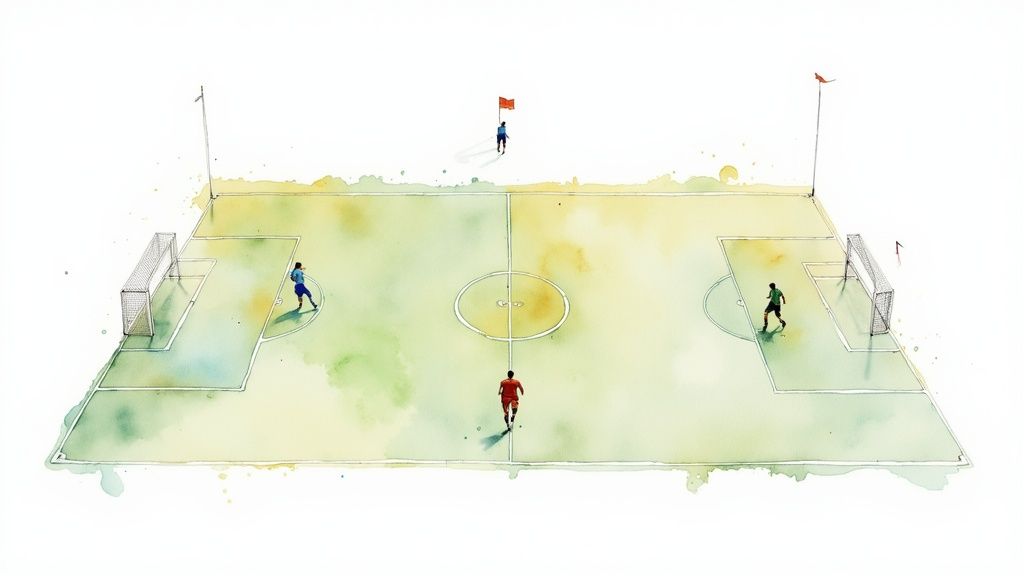
The easiest way to see the field like a pro is to break it down into three horizontal sections:
- Defensive Third: This is your team's half closest to the goal you are defending. The priority here is preventing the opposition from scoring through disciplined positioning and safe play.
- Middle Third: This is the engine room of the field, located between the two penalty areas. The team that controls the middle third often controls the pace and flow of the game.
- Attacking Third: This is the area in the opponent's half where your team is trying to score. In this zone, players are encouraged to take risks, be creative, and shoot on goal.
Step 3: Recognizing Field Size Variations
Not all soccer fields are the same size. Pitches are often scaled to fit the players—from young children just learning the game to professionals competing on the world stage. This flexibility makes soccer accessible to all ages and skill levels.
- Youth Leagues (U6-U12): Fields are significantly smaller, ranging from 30x20 yards for the youngest players to around 75x45 yards for pre-teens. This ensures kids get more touches on the ball and have more fun.
- High School & NCAA: At this level, fields begin to resemble professional pitches. The NCAA, for example, requires a width between 70 and 75 yards to maintain a consistent standard for student-athletes.
- Professional Standard: Most top-tier professional stadiums, like those used in the World Cup, have settled on a standard of 105 by 68 meters (about 115 x 74 yards). This uniformity ensures a level playing field for elite competition. You can explore the specific dimensions used across all MLS soccer fields on our platform.
Tips, Best Practices, or Common Mistakes
Knowing the layout of a soccer field is one thing, but using that knowledge under pressure is what separates good players from great ones. Here are common mistakes to avoid:
- Getting Caught Offside: An attacker drifts past the last defender before the ball is played. This common error instantly kills a promising attack. Always be aware of your position relative to the defenders.
- Fouling Inside the Penalty Area: A desperate tackle just inside the 18-yard box is far more costly than one just outside it. That single step can be the difference between a free-kick and a game-changing penalty.
- Illegal Throw-ins: A frequent mistake is lifting a foot off the ground while taking a throw-in. This results in a foul throw and loss of possession. Both feet must remain on the ground.
- Encroaching on Restarts: During corner kicks or free kicks, players might creep over the required distance before the ball is kicked. This simple foul lets the defending team off the hook.
Understanding how others rate local pitches can also give you a heads-up on field conditions. Check out these detailed soccer field reviews to see what others are saying about the quality of the markings and turf in your area.
Examples or Case Studies
Let's look at how the field in soccer directly impacts real-game scenarios:
- Case Study: The Counter-Attack: A team defends deep in their Defensive Third. After winning the ball, they quickly play a long pass into the Attacking Third for a fast striker to run onto. This strategy uses the full length of the field to bypass the congested Middle Third and create a quick scoring chance.
- Example: Mastering the Half-Spaces: Modern tactics heavily feature the "half-spaces"—the vertical channels between the wide areas and the center of the pitch. A player like Kevin De Bruyne receives the ball in the half-space within the Attacking Third. This forces a defender to choose: step out and leave a gap, or stay put and allow the attacker time and space. This tactical use of a specific field zone creates chaos for defenses.
- Scenario: The Impact of Field Width: A team playing on a narrow field (e.g., 55 yards wide) might struggle to find space and play through the wings. On a wider professional field (75 yards wide), the same team has more room to spread the play, switch the ball from one side to the other, and stretch the opponent's defense.
Making players understand these zones is a fundamental part of coaching. If you’re passionate about shaping a team's tactical mind, you might want to explore career opportunities as a coach.
FAQ
What is the standard professional soccer field size?
While sizes can vary, the unofficial "gold standard" for a professional field in soccer is 105 by 68 meters (about 115 by 74 yards). This dimension is preferred for top-tier leagues and international tournaments like the FIFA World Cup to ensure consistency.
Why are youth soccer fields smaller?
Youth soccer fields are intentionally scaled down to fit the age and physical development of the children playing. Smaller fields ensure kids are more involved in the game, get more touches on the ball, and can focus on skill development without being overwhelmed by a massive playing area.
How much can soccer field dimensions vary?
According to FIFA's Laws of the Game, the dimensions for non-international matches can vary significantly: length can be anywhere from 100 to 130 yards (90 to 120 meters), and width can range from 50 to 100 yards (45 to 90 meters). This flexibility allows the game to be played in various locations, from local parks to large stadiums.
What is the most important line on the field?
Many coaches would argue the lines that form the penalty area (the "18-yard box") are the most important. A defensive foul inside this box results in a penalty kick—a high-percentage scoring opportunity. The rules for the goalkeeper also change within this area, making it the most critical zone for both attack and defense.
Are indoor soccer fields different?
Yes, significantly. indoor soccer fields are much smaller, often feature artificial turf, and are typically enclosed by walls or netting that can be used in play. The smaller size leads to a faster-paced game with more emphasis on quick passing and ball control.
Conclusion / Summary
We've covered everything from the official dimensions and crucial markings to the strategic zones that define modern tactics. The key takeaway is that the field in soccer isn't just a patch of grass; it's a dynamic chessboard where rules, strategy, and skill collide. Understanding its layout is your ticket to a deeper appreciation for the beautiful game. The next time you watch or play, notice how teams use the field's width, defend the penalty area, or control the middle third.
Call-to-Action
Ready to put your knowledge to the test? The best way to understand the field is to get on it. Use our tool to find a soccer field near me and see these concepts come to life in a real game.