A Guide to the Dimensions of the Soccer Field
November 14, 2025
Ever wonder why some soccer fields feel absolutely massive, while others seem surprisingly compact? The truth is, they're not all the same. The dimensions of the soccer field are a critical, often overlooked, element that shapes every single match, from a local youth league game to the World Cup final. This guide will walk you through official FIFA regulations, youth field scaling, and what every line on the pitch means.
Why Understanding Soccer Field Dimensions Matters
Knowing the layout of a soccer field is essential for players, coaches, and even dedicated fans. Field size directly influences team strategy, player positioning, and the overall pace of the game. For parents and youth coaches, using age-appropriate field dimensions is crucial for skill development, ensuring young players get more touches on the ball and build confidence. Whether you're a coach designing drills or a fan analyzing a professional match, a clear understanding of the pitch's layout enriches your experience of the beautiful game.
A Guide to Soccer Field Dimensions and Markings
The size and markings of a soccer pitch are standardized by the Fédération Internationale de Football Association (FIFA) to ensure fairness and consistency in the game. However, there is a permitted range in size, which allows for some variation between stadiums. This section breaks down the official measurements for professional play and explains the purpose of every line on the field.

Official FIFA Field Dimensions
For professional soccer, FIFA's regulations provide a range for field dimensions, with stricter rules for international competitions.
- Length (Touchline): A standard professional field must be between 90 and 120 meters (100 to 130 yards) long. For international matches, this is narrowed to 100 to 110 meters (110 to 120 yards).
- Width (Goal Line): The width for standard matches can range from 45 to 90 meters (50 to 100 yards). International matches require a width between 64 and 75 meters (70 to 80 yards).
This is a crucial difference to understand, as is the contrast between outdoor pitches and the much smaller indoor soccer field dimensions.
Key Field Markings Explained
- Penalty Area: Often called the "18-yard box," this is the larger box extending 16.5m (18 yds) from the goal line. The goalkeeper is allowed to handle the ball within this area, and fouls committed by the defending team here result in a penalty kick.
- Goal Area: The smaller box, or "6-yard box," extends 5.5m (6 yds) from the goal line. Goal kicks are taken from within this area.
- Penalty Mark: A spot located 11m (12 yds) from the center of the goal line, where all penalty kicks are taken.
- Center Circle: This has a radius of 9.15m (10 yds) from the center mark of the field. At kickoff, all players from the opposing team must remain outside this circle until the ball is played.
- Corner Arc: A small quarter-circle with a 1m (1 yd) radius at each of the four corners of the field. The ball must be placed within this arc for a corner kick.
Tips and Best Practices
Understanding the dimensions is one thing; applying that knowledge is another. Here are a few tips for players, coaches, and facility managers.
- Coaches: Use the field's dimensions to your advantage. On a wider pitch, focus on drills that exploit the wings. On a narrower field, practice quick transitions and compact defensive shapes.
- Players: Develop your spatial awareness. Know where the lines are without looking down. Understanding the distance from the penalty area to the halfway line can help you time your runs and maintain defensive positioning.
- Youth Leagues: Always use the correct, scaled-down field and goal sizes for each age group. This is the single most important factor in fostering skill development and preventing player burnout.
Youth Soccer Field Dimensions: An Example
A full-sized pitch is too large for young players, which is why youth soccer leagues use scaled-down fields. This ensures kids have more opportunities to touch the ball, score goals, and develop fundamental skills without becoming exhausted.
For example, a U10 team plays on a field that is drastically different from a professional one.
- Field Size: Typically around 55-65 yards long and 35-45 yards wide. This smaller space encourages more passing and teamwork.
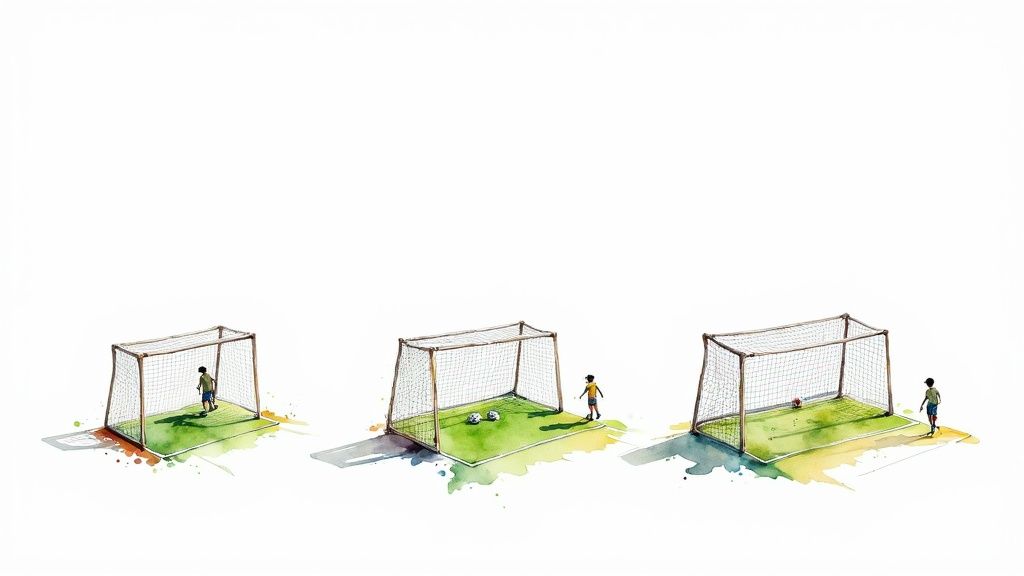
- Goal Size: The goals are also smaller, usually 6.5 x 18.5 feet, to match the size of the young goalkeepers.
- Player Numbers: Games are often 7v7 instead of 11v11, which prevents the field from becoming overly congested.
Organizations like the Utah Youth Soccer Association adhere to these age-appropriate standards to create an optimal learning environment. This progressive scaling helps players gradually adapt to the challenges of a full-sized pitch as they grow older.
FAQ: Dimensions of the Soccer Field
Are all professional soccer fields the same size?
No. While international match fields are strictly regulated (110-120 yards long, 70-80 yards wide), professional club fields can vary within a broader FIFA-approved range (100-130 yards long, 50-100 yards wide). This allows for unique stadium characteristics and can create a home-field advantage for teams accustomed to a specific pitch size.
What is the small box inside the penalty area for?
That is the goal area, commonly called the "6-yard box." Its primary functions are to designate the area from which a goal kick must be taken and to provide additional protection for the goalkeeper within that space.
What is the arc on top of the penalty box?
The half-circle is the penalty arc. Its sole purpose is to ensure that all players (except the penalty taker and goalkeeper) remain at least 10 yards away from the penalty spot during a penalty kick. It serves as a visual boundary for player positioning.
Why are soccer fields sometimes marked on American football fields?
This is common in the United States where multi-purpose stadiums are prevalent. While practical, it often results in a soccer pitch that is on the narrow end of the regulation width. This can lead to a more congested, physical, and direct style of play compared to games on wider fields.
Conclusion
The dimensions of the soccer field are far more than just arbitrary lines on the grass; they are the foundation of the game's strategy, flow, and player development. From the vast pitches of international stadiums like those in the MLS soccer stadiums list to the scaled-down fields for youth leagues, every measurement serves a purpose. Understanding these details gives coaches a tactical edge, helps players improve their spatial awareness, and provides fans with a deeper appreciation for the beautiful game.
Take the Next Step
Now that you're an expert on the dimensions of the soccer field, put your knowledge to use! Use our interactive map to find a soccer field near you and see these measurements in person.